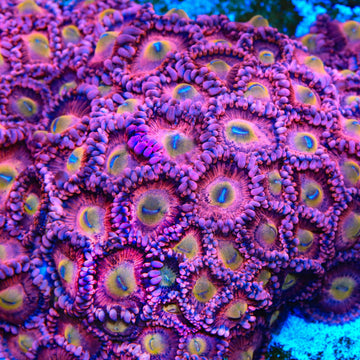
JF Yellow Fever Montipora Coral
Overview
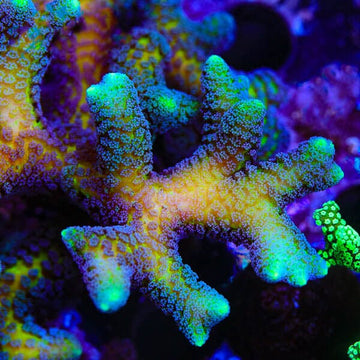
JF Yellow Fever Montipora Coral shows bright yellow encrusting to plating growth with small, uniform polyps. Montipora sp. is a small-polyp stony coral that prefers moderate to high light and strong, turbulent water flow. It is photosynthetic with symbiotic algae but can accept occasional fine particulate foods to support growth and color. Place on stable rock with space from aggressive corals, and avoid shading as it spreads.
Quick Facts
Care
Moderate
Lighting
Moderate–High
Flow
Moderate–High
Placement
Mid–High
Temperament
Peaceful (1–2 inches spacing)
Recommended Parameters
Temp
76–80°F
pH
8.1–8.4
Salinity
1.025–1.026
Calcium
400–450 ppm
AlkAlkalinity
7.5–9 dKH
Magnesium
1250–1350 ppm
Feeding
photosynthetic, phytoplankton, micro-zooplankton, rotifers, microplankton, marine snow, powdered coral foods, amino acid supplements
Care & Placement
FAQ
Frequently Asked Questions
About the JF Yellow Fever Montipora Coral
-
Why does the JF Yellow Fever Montipora lose its bright yellow and turn green or brown?
Color shifts often reflect spectrum, nutrients, and trace balance. Aim for stable NO3 ~5–15 ppm, PO4 ~0.03–0.08 ppm; ULNS can wash out yellow. Provide strong, full-spectrum light with some white (not only heavy blue). Maintain alk 8–9 dKH, Ca ~420 ppm, Mg ~1300 ppm. Low iron or iodine can mute yellow; consider cautious trace supplementation and reduce shading to keep pigments vibrant. -
Why does this Montipora sometimes plate and other times just encrust?
Growth form responds to light, flow, and available surfaces. High, turbulent flow with high PAR often drives plating shelves once a solid base forms; very strong flow with moderate PAR favors tight encrusting. Let it secure a wide base before pushing PAR upward to limit edge burn. Avoid laminar jets that cause flat, windblown plates; seek random, intersecting currents for balanced architecture. -
What’s the best way to detect and manage Montipora-eating nudibranchs on this coral?
Look for crescent bite marks and pale edges; inspect at night with a flashlight for tiny white nudibranchs and egg spirals under ledges. Quarantine new frags, use repeated, coral-safe dips every 3–4 days to break egg cycles, and manually remove eggs. A vigilant wrasse (e.g., melanurus) can help, but won’t cure infestations. Isolate affected pieces and stabilize parameters to speed recovery. -
My polyps barely extend—how do I judge health and improve extension without stressing it?
Montipora polyps can be subtle, so watch for steady rim growth, fresh encrustment, and even coloration. Poor extension usually traces to alkalinity swings, too-laminar flow, or nipping fish. Verify stable alk (daily swing <0.2 dKH), redirect pumps for chaotic flow, and rule out pests. Activated carbon and good skimming help when soft coral chemicals or toxins suppress polyp behavior.