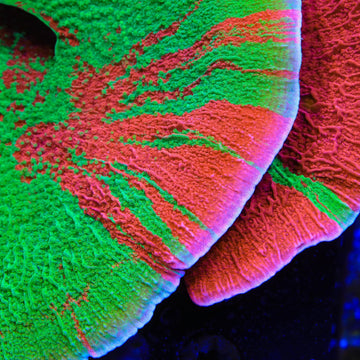
JF Fruity Pebbles Montipora Coral
Overview
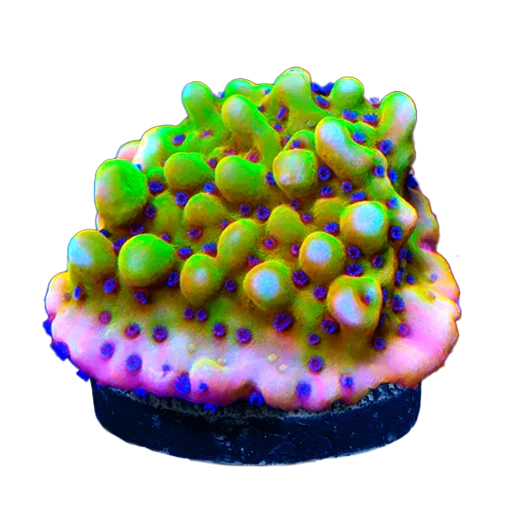
JF Fruity Pebbles Montipora Coral shows multicolored branching tips with small polyps across finger-like growths. Montipora digitata is a small polyp stony branching coral that prefers moderate to strong light and moderate to strong, turbulent water flow. It is primarily photosynthetic via symbiotic algae but benefits from occasional fine particulate foods, which can support growth and sustain coloration. Place high on stable rockwork with room for vertical growth, and keep distance from aggressive stingers to avoid tissue damage.
Quick Facts
Care
Moderate
Lighting
Moderate–High
Flow
Moderate–High
Placement
Mid–High
Temperament
Peaceful (2–3 inches spacing)
Recommended Parameters
Temp
76–80°F
pH
8.1–8.4
Salinity
1.025–1.026
Calcium
420–450 ppm
AlkAlkalinity
8–9.5 dKH
Magnesium
1280–1350 ppm
Feeding
photosynthetic, phytoplankton, micro-zooplankton, rotifers, marine snow, powdered coral foods (e.g., Reef-Roids), amino acid supplements
Care & Placement
FAQ
Frequently Asked Questions
About the JF Fruity Pebbles Montipora Coral
-
Why does my JF Fruity Pebbles Montipora lose pinks/reds while greens remain?
Color shifts often track spectrum and trace balance. Strong blue/UV preserves greens, but reds/pinks fade with low potassium/iodine and excess white. Aim PAR ~200–300 with balanced blue, keep NO3 5–15 ppm, PO4 0.03–0.08 ppm. Dose/verify potassium and iodine via ICP. Avoid ultra-low nutrients; mild amino dosing can help, but overdoing fuels algae. -
My digitata’s base is receding while tips grow—what’s causing the “shadow dieback”?
Dense branching can shade the base, starving zooxanthellae. Increase cross-flow to deliver nutrients and reduce detritus, rotate the colony or prune inner branches to open light lanes, and slightly widen spectrum (add some violet/near-UV). Check alkalinity stability; rapid swings accelerate tissue loss in shaded areas. Siphon detritus trapped at the base weekly. -
What pests or competitors uniquely trouble this morph, and how do I spot them early?
Montipora-eating nudibranchs favor digitatas; check at night with a flashlight for tiny white slugs and crescent bite marks. Dip new frags (oxidizing or organophosphate dips per label) and inspect for egg spirals under the branches. Nearby aggressive LPS can sting tips; soft coral allelopathy dulls color—run fresh carbon and maintain good skimming. Maintain stable alkalinity to resist tissue loss. -
Are my flow patterns causing blunt, stubby branches instead of elegant forks?
Likely laminar flow is battering the tips. Switch to alternating, wide gyre-style or randomized pulses to encourage elongated, forked growth. Place the colony where multiple streams intersect softly. Keep alk 7.5–8.5 dKH and avoid rapid jumps; tip burn halts extension. Slightly higher PAR at the upper tips (250–300) promotes finer branching without bleaching.