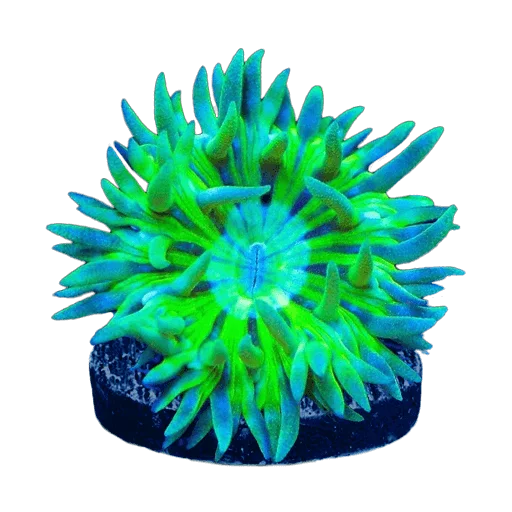
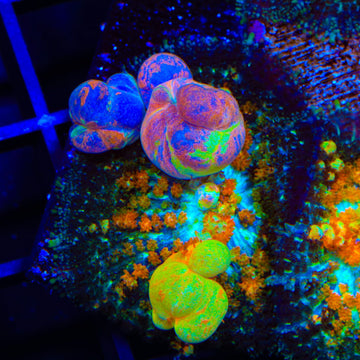
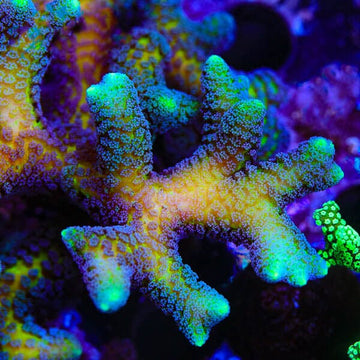
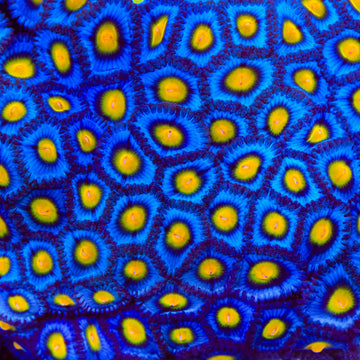
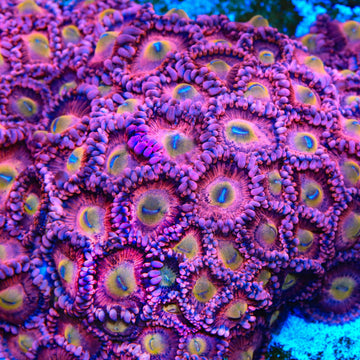
JF Fairy Fart Zoanthids Coral
Overview
JF Fairy Fart Zoanthids Coral shows small button polyps with bright mouths and contrasting skirts. Classified as Zoanthus sp., this soft colonial polyp grows as mats; it prefers moderate light and moderate, stable water flow. It is photosynthetic via symbiotic algae but accepts small meaty foods, which can support faster growth and richer color. Place on an isolated rock to manage spreading, and handle with care due to potential palytoxin.
Quick Facts
Care
Easy
Lighting
Low–Moderate
Flow
Moderate
Placement
Low–Mid
Temperament
Peaceful to semi-aggressive (fast-growing; allow 2–3 inches spacing)
Recommended Parameters
Temp
76–82°F
pH
8.1–8.4
Salinity
1.025–1.026
Calcium
380–420 ppm
AlkAlkalinity
8–10 dKH
Magnesium
1250–1350 ppm
Feeding
Photosynthetic, microplankton, phytoplankton, rotifers, copepod nauplii, baby brine shrimp, powdered coral foods (e.g., Reef-Roids), amino acid supplements
Care & Placement
FAQ
Frequently Asked Questions
About the JF Fairy Fart Zoanthids Coral
-
My JF Fairy Fart Zoanthids faded from neon to pastel—how can I restore the pop?
This morph colors best under moderate PAR (80–150) with strong violet/UV (405–430 nm) and balanced blues. Excess white or very high PAR can wash pigments; too low nutrients can pale skirts. Keep nitrate 5–15 ppm, phosphate 0.03–0.1 ppm, and stable alkalinity. Gradually adjust lighting over 1–2 weeks. A light acclimation ramp and slight increase in blue/violet usually brings fluorescence back within a few growth cycles. -
They’re growing but not opening fully; skirts stay tight. What’s the likely culprit?
Often it’s turbulent flow angle, vermetid irritation, or chemical warfare. Aim for moderate, indirect flow so skirts flutter, not blast. Inspect for vermetid webs, zoa-eating nudibranchs, and sundial snails—check at night with a flashlight. Run fresh carbon and maintain 10–15% weekly water changes after adding new softies. If recently changed lighting, reduce intensity 20–30% and ramp slowly to prevent photoinhibition. -
Will JF Fairy Fart overrun my rockwork, and how can I manage spread without stunting growth?
Zoanthus spreads by encrusting mat. Use isolated “islands” or sand gaps to contain it. Create removable tiles near the colony so it grows onto them for easy harvest. Regularly trim edges rather than center polyps to reduce stress. Maintaining moderate nutrients and flow encourages vertical polyp density over runaway mat creep. Avoid placing next to slow LPS; the mat can shade and irritate fleshy neighbors. -
They stopped responding to food and seem to shrink—feed more or change conditions?
This morph usually thrives on dissolved nutrients and occasional fine foods (cyclops, reef roids). If polyps ignore food and shrink, check for parameter swings (alk, salinity), pests, or overly low nutrients. Aim for steady alk 8–9.5 dKH, nitrate above 2–3 ppm, phosphate detectable. Increase flow slightly and reduce feeding; excess powders can fuel film algae that irritates the mat. Once stable, resume light feeding weekly.