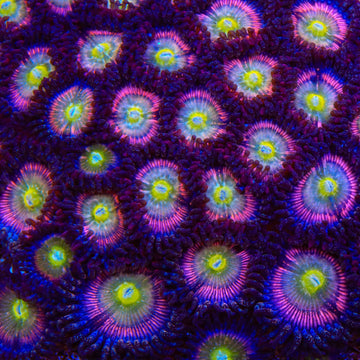
JF Daisy Cutter Zoanthids Coral
Overview
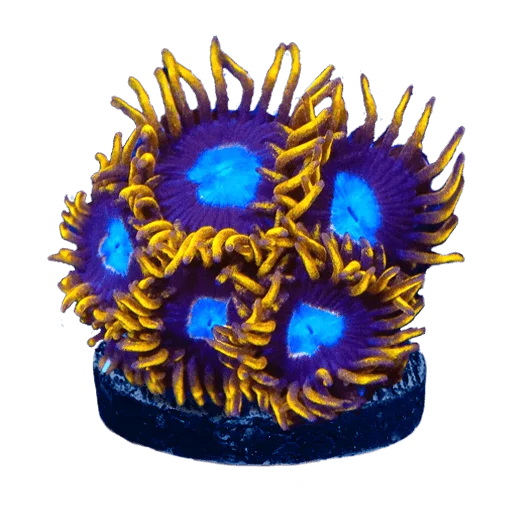
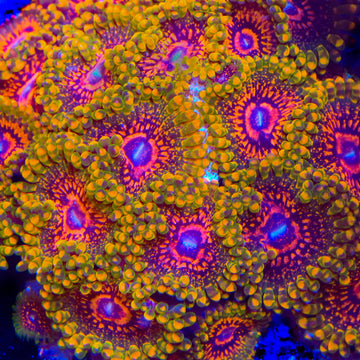
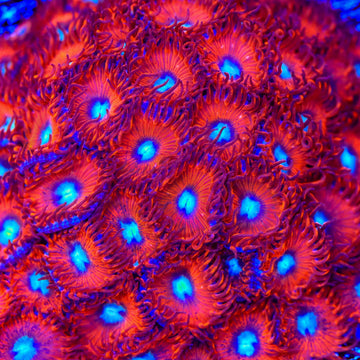
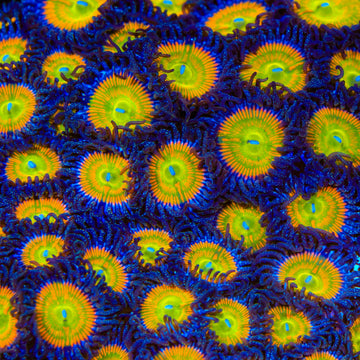
JF Daisy Cutter Zoanthids Coral displays tight clusters of button-like polyps with a daisy-patterned center and short fringe tentacles. Zoanthus sp., a soft colonial polyp, thrives under moderate lighting and gentle to moderate water flow. It is primarily photosynthetic via symbiotic algae but accepts fine meaty foods, which can speed growth and maintain color. Place on a separate rock to control spreading and give space from aggressive neighbors; handle with care to avoid exposure to palytoxin.
Quick Facts
Care
Easy
Lighting
Moderate
Flow
Moderate, indirect
Placement
Low–Mid
Temperament
Peaceful to semi-aggressive (fast-growing; provide moderate spacing)
Recommended Parameters
Temp
76–82°F
pH
8.1–8.4
Salinity
1.025–1.026
Calcium
380–450 ppm
AlkAlkalinity
8–10 dKH
Magnesium
1250–1350 ppm
Feeding
photosynthetic, microplankton, phytoplankton, rotifers, cyclops, powdered coral foods, reef roids, oyster eggs
Care & Placement
FAQ
Frequently Asked Questions
About the JF Daisy Cutter Zoanthids Coral
-
My JF Daisy Cutter Zoas look dull under my lights. How can I keep their vibrant “daisy” pattern?
Prioritize strong blue spectrum (actinic-heavy) and moderate PAR (80–150). Too much white light can wash out fluorescence; too little light causes stretching and muted skirts. Light-acclimate new frags over 1–2 weeks. Maintain nutrients in the “non-starved” zone (NO3 2–10 ppm, PO4 0.03–0.1) to support coloration. Stable alkalinity (8–9.5 dKH) and gentle, indirect flow help keep polyps clean and open. -
These Zoanthus spread fast. What’s the best way to control growth without hurting the colony?
Mount them on an isolated rock “island” surrounded by sand to limit mat creep. For trimming, use a clean scalpel to cut the mat between polyps, avoiding the oral disc. Wear eye/skin protection due to potential toxins. Glue cut sections to fresh plugs and provide moderate flow for healing. Remove encroaching runners early; carbon use and spacing reduce chemical skirmishes with nearby corals. -
My Daisy Cutters stayed closed for days after a dip. Could pests still be present?
Persistent closure often points to zoa-eating nudibranchs, sundial snails, or spiders. Inspect at night with a flashlight; look for egg spirals under skirts. Follow up with staged dips (iodine or commercial dip) 3–4 times over 10–14 days to break life cycles. Ensure enough but not blasting flow to clear detritus. Check for fish nipping (angels, butterflies) and bristleworm irritation in dense mats. -
I’m seeing “melting” in a few polyps while others look fine. What’s the likely cause and fix?
Localized melt often follows parameter swings or shipping stress, sometimes compounded by bacterial film in low flow. Stabilize salinity and alkalinity, reduce light temporarily, and increase gentle, random flow across the mat. Perform an iodine dip on affected frags. Avoid ultra-low nutrients; target NO3 5 ppm and PO4 0.05 ppm. Siphon decaying tissue promptly to prevent spread, then resume normal light over several days.