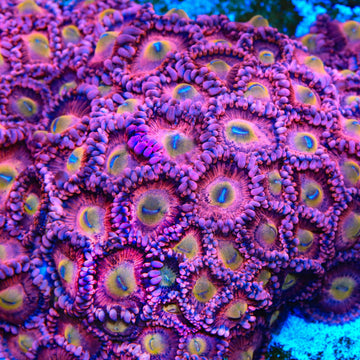
JF Acid Reflux Zoanthids Coral
Overview
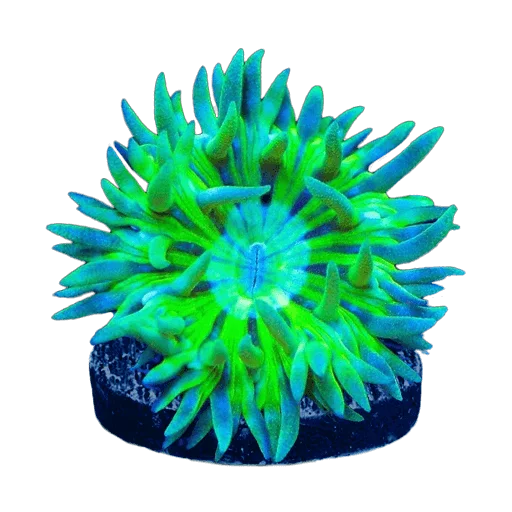
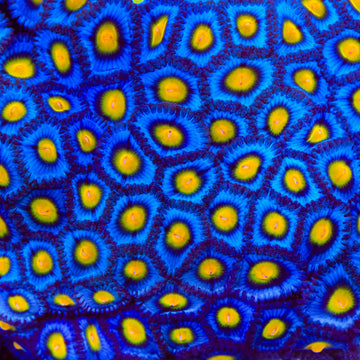
JF Acid Reflux Zoanthids Coral features small button polyps with bright green centers and contrasting skirts. Zoanthus sp. Coral is a soft, colonial polyp that forms mats and does well under moderate light and low to moderate water flow. It is photosynthetic with symbiotic algae but will accept small meaty foods; occasional feeding supports growth and color. Place on an isolated rock to limit spreading and keep space from aggressive stinging corals.
Quick Facts
Care
Easy
Lighting
Low–Moderate
Flow
Moderate
Placement
Low–Mid
Temperament
Semi-aggressive (2–3 inches spacing)
Recommended Parameters
Temp
78–80°F
pH
8.1–8.4
Salinity
1.025–1.026
Calcium
400–450 ppm
AlkAlkalinity
8–10 dKH
Magnesium
1250–1350 ppm
Feeding
photosynthetic (primary), microplankton, phytoplankton, zooplankton, rotifers, copepods, cyclops, brine shrimp nauplii, finely chopped mysis, coral-specific powdered foods
Care & Placement
FAQ
Frequently Asked Questions
About the JF Acid Reflux Zoanthids Coral
-
Why did my JF Acid Reflux Zoanthids Coral fade from neon to dull tones after moving higher in the tank?
This morph is highly spectrum-sensitive. Excess white or rapid PAR increases can wash out pigments. Shift to a blue/UV-heavy range (peaks ~420–460 nm), reduce overall intensity, and light-acclimate over 2–3 weeks. Keep nutrients non-zero (NO3 5–15 ppm, PO4 0.03–0.10), and maintain stable alk 8–9 dKH. Trace balance (notably iron) can influence greens; avoid aggressive carbon dosing that strips nutrients. -
My polyps look “stretched” with long skirts—what is the tank telling me?
Elongated stalks and skirts usually signal low light or inconsistent flow. Increase PAR gradually or move the colony slightly upward, and provide moderate, cross-current flow that keeps detritus off the mat without blasting the polyps. Compact, open polyps with defined skirts indicate a good balance. If only some heads stretch, micro-shadowing may be the culprit; rotate or re-angle the frag. -
Which pests target JF Acid Reflux Zoanthids Coral, and how do I confirm and treat them?
Watch for zoa-eating nudibranchs (often matching polyp color), sundial snails, and zoa spiders, mostly active at night. Inspect after lights out with a flashlight and check undersides of the mat. Quarantine new pieces, and use targeted dips (iodine or commercial coral dips). For nudibranch eggs (crescent clusters), manually remove and repeat dips every 3–4 days for two weeks to break the cycle. -
How do I handle sudden “melting” or suspected zoa pox in this morph?
Act fast: increase flow around the colony, gently turkey-baste detritus, and stabilize nutrients. Perform Lugol’s iodine dips; for pox-like lesions, a Furan-2 bath series can help. Remove dying polyps to prevent bacterial spread. Avoid drastic parameter swings, especially salinity and alkalinity. If neighboring corals are releasing chemicals, run fresh carbon and add space; chemical stress often precedes tissue collapse.