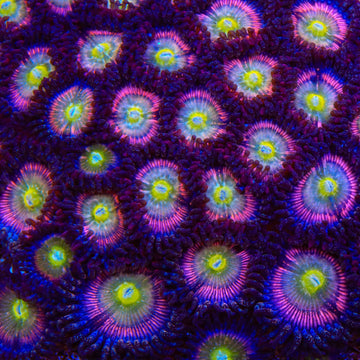
Jawbreaker Zoanthids Coral
Overview
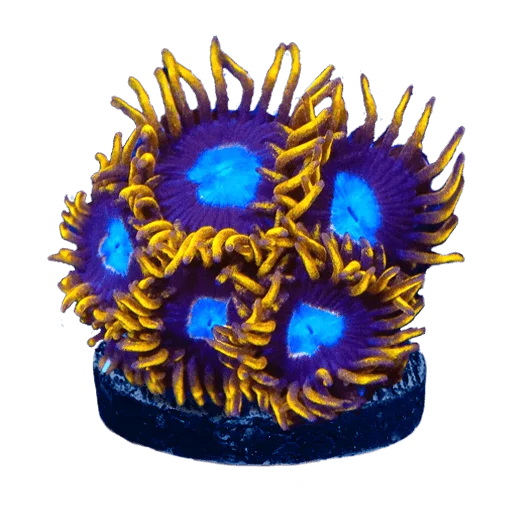
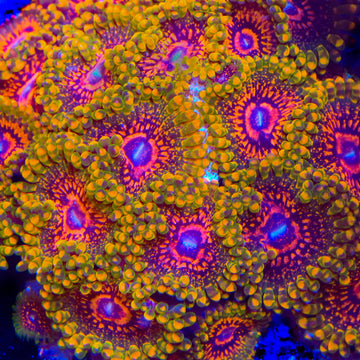
Jawbreaker Zoanthids Coral shows mottled orange to red button-like polyps with irregular yellow or green streaks. Zoanthus sp., a colonial soft polyp, grows on a mat and does best under moderate light and low to moderate water flow. It is photosynthetic with symbiotic algae but accepts occasional small planktonic foods, which support growth and help maintain coloration. Place on an isolated rock to control spread, keep space from stinging neighbors, and handle with care due to potential toxins.
Quick Facts
Care
Easy
Lighting
Moderate
Flow
Moderate
Placement
Mid–Low
Temperament
Semi-aggressive (fast grower; allow 2–3 inches spacing)
Recommended Parameters
Temp
76–80°F
pH
8.1–8.4
Salinity
1.025–1.026
Calcium
380–430 ppm
AlkAlkalinity
8–10 dKH
Magnesium
1250–1350 ppm
Feeding
photosynthetic, phytoplankton, rotifers, cyclops, microplankton, coral-specific powdered foods, marine snow
Care & Placement
FAQ
Frequently Asked Questions
About the Jawbreaker Zoanthids Coral
-
Why are my Jawbreaker Zoanthids fading from red/orange to dull green under stronger lighting?
Rapid jumps in PAR often wash out warm pigments. Start them low and ramp light over 2–3 weeks. Blue-heavy spectrum (actinic) tends to preserve reds/oranges; excessive white can mute them. Keep nutrients non-zero (nitrate 5–15 ppm, phosphate 0.03–0.1 ppm). If polyps look small and tight, reduce intensity or raise the colony. Stable alkalinity and iodine at natural levels also help color retention. -
My colony stays closed with long, stretched skirts—what’s the likely cause?
That combo points to low, laminar flow and potential irritants. Increase random flow so skirts flutter but polyps aren’t blasted. Inspect at night for zoa-eating nudibranchs, sundial snails, and spiders. Perform a thorough dip (iodine-based, then rinse) and manually remove eggs. Check for detritus buildup at the base and for film algae shading the mat. Stability in salinity and temperature speeds recovery. -
Can targeted feeding improve growth or color on this morph?
Yes—occasional micro-feeds help. Once or twice weekly, gently waft fine foods (e.g., rotifers, reef snow, powdered zoa foods) over open polyps with pumps off for 10–15 minutes. Avoid large meaty foods; they foul and won’t be consumed. Resume flow to disperse leftovers. Feeding is most effective when nutrients aren’t stripped; run carbon sparingly and avoid aggressive nitrate/phosphate removal during growth phases. -
How do I prevent “zoa melt” after a stress event or shipment?
Pre-empt with temperature-matched dips (iodine or Furan-2 for suspected bacterial issues), then place in moderate, turbulent flow to keep the mat clean. Avoid ULN conditions—keep some nitrate and phosphate present. Run fresh activated carbon to reduce allelopathy from soft corals. Don’t chase parameters; prioritize stability in alk, salinity, and temp. If recession continues, frag healthy edges away from the necrotic zone.