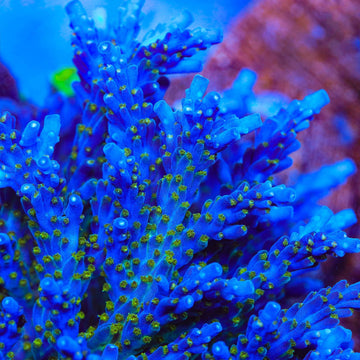
Jake Adams Immortal Tort Acropora Coral
Overview
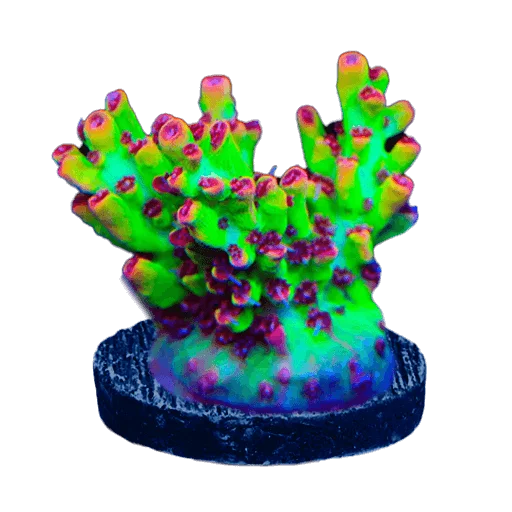
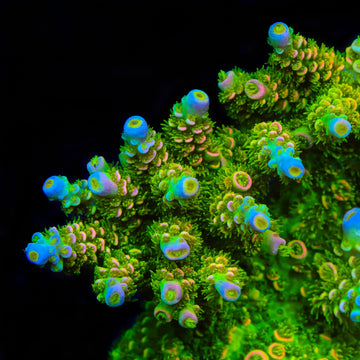
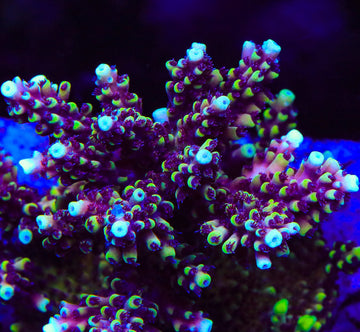
Jake Adams Immortal Tort Acropora Coral shows dense, upward-branching, tortuous branches with blue to teal tips. Acropora tortuosa is a small-polyp stony, branching coral that prefers strong light and high, turbulent flow. It relies on symbiotic algae for most nutrition but accepts occasional fine particulate foods, which can support growth and color. Place high on stable rockwork with space from aggressive neighbors, and keep alkalinity and temperature very stable.
Quick Facts
Care
Difficult
Lighting
High
Flow
High
Placement
High
Temperament
Semi-aggressive (3–4 inches spacing)
Recommended Parameters
Temp
77–80°F
pH
8.1–8.4
Salinity
1.025–1.026
Calcium
420–450 ppm
AlkAlkalinity
7.5–9 dKH
Magnesium
1280–1350 ppm
Feeding
photosynthetic (primary), microplankton, rotifers, copepod nauplii, coral-specific powdered foods, amino acid supplements, marine snow
Care & Placement
FAQ
Frequently Asked Questions
About the Jake Adams Immortal Tort Acropora Coral
-
Why does my Jake Adams Immortal Tort shift from electric blue to teal or brown, even with strong lighting?
This coral’s pigments respond to spectrum, nutrients, and stability. Prioritize high PAR (300–450) with strong violet/UV channels and moderate blues; minimize excess white. Keep nitrate 5–15 ppm and phosphate 0.03–0.08 ppm—too lean pales it, too rich dulls it. Avoid rapid alkalinity moves; maintain 8–9 dKH stable. Slightly higher iron can help blues, but dose conservatively and test. -
How can I keep the classic tortuosa spiral branching without the colony shading itself out?
Provide cross-flow that alternates direction to encourage even axial growth; avoid a single laminar blast. Mount the base vertically with room for outward branching, leaving 3–4 inches to neighbors. Periodically trim inner, downward-facing branches to open light channels. Raise PAR gradually as the colony densifies to counter self-shading, and rotate the frag/colony 90° every few weeks during early growth. -
My polyp extension is minimal by day but great at night—should I feed it more?
Daytime retraction is common with high flow and bright light. Focus on stable parameters and strong, chaotic flow. Occasional broadcast feeding of fine particulate foods and amino acids after lights dim can improve tissue fullness, but don’t overfeed. Measure nutrients weekly to avoid spikes. If extension suddenly declines both day and night, check for pests (AEFW, red bugs) and verify flow paths. -
What’s a reliable approach when this coral shows early STN from the base?
First, halt swings: verify temp, salinity, and alkalinity. Increase turbulent flow around the affected area and gently baste detritus from the base. Trim 3–5 mm into healthy tissue and remount frags on clean plugs to preserve the lineage. Consider a broad-spectrum coral dip to rule out pests, improve gas exchange, and run fresh carbon. Avoid large water chemistry corrections; dose in small steps.