Vlamingii Tang saltwater fish care guide

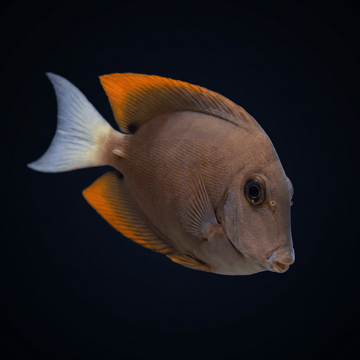
Naso vlamingii is one of the largest unicornfishes available to home aquarists, reaching roughly 24 inches across its Indo-Pacific range. Adults wear a base of bluish-grey, brown, or purple-brown overlaid with fine blue spots and lines, a broad blue band across the face, and a rounded bump on the snout. The dorsal and anal fins grow unusually tall, and the caudal lobes extend into long filaments that trail behind a mature fish as it cruises. Juveniles are far more subdued, showing grey or brown bodies marked with scattered blue spotting, which makes the transformation into adult coloration one of the more dramatic developments in a large reef system.

In the wild this species patrols deep lagoons, seaward reefs, steep slopes, and drop-offs, sometimes alone or in pairs, sometimes in loose schools or mid-water feeding aggregations. Replicating that open-water lifestyle is the central challenge in captivity. A minimum of 240 gallons is appropriate for an adult, and the layout matters as much as the volume: long, unobstructed swimming lanes and generous turning room at both ends of the aquarium. Build secure rockwork that offers a few crevices and retreats without crowding the open water, and avoid packing the display so densely with rock and coral that the fish cannot move freely. An established, mature system is strongly preferred, with moderate general circulation, some areas of stronger flow, and high dissolved oxygen. Fit a tight-fitting lid, since startled individuals may attempt to jump.

Wild Vlamingii Tangs feed in two distinct ways, picking zooplankton from the water column well above the reef and also grazing algae from hard surfaces. That dual strategy places the species squarely in the omnivore category, and captive feeding should reflect both halves of the natural diet. Offer dried seaweed and prepared marine algae alongside meaty items such as mysis, krill, plankton, and finely chopped marine seafood. Spirulina-based preparations are a useful addition to the plant portion of the rotation.

Given the fish's size and activity level, frequent meals are important. Feed at least twice daily, and secure dried seaweed to a clip or rock face at least three times per week so the fish can graze between prepared feedings. Because a large tang burns through energy constantly in open water, thin body condition is a warning sign worth monitoring. When selecting a specimen, confirm that it is already eating; healthy individuals normally accept aquarium foods readily and settle into a routine without difficulty.

Dried Seaweed Marine Algae Spirulina Foods Mysis Shrimp Krill Plankton Chopped Marine Seafood
This is a restless, open-water swimmer that spends most of the day patrolling the length of the aquarium rather than hiding in the rockwork. It generally coexists well with unrelated reef fishes, but it can turn aggressive toward other surgeonfishes and is particularly prone to quarreling with members of its own genus. Introduce it as one of the larger residents only after smaller and more timid fishes have established themselves, and avoid pairing it with similarly shaped tangs in anything less than an enormous system. Keeping a single specimen is the simplest approach; groups are possible only in very large aquariums, and a second large male should never be added to an established individual. Adult size and a substantial bioload mean that crowding is never an acceptable compromise with this species.

In the reef aquarium, the Vlamingii Tang is reef safe and reliably leaves corals and sessile invertebrates alone. Reports of predation on shrimp, crabs, snails, clams, or small fishes are absent, and its grazing helps control nuisance algae on rock and glass. The real limitation is spatial rather than dietary: a fish of this size needs broad, clear swimming corridors, so a densely aquascaped display with little open water is a poor match regardless of how peaceful the fish is toward the corals themselves.

FAQ

Frequently Asked Questions

About the Vlamingii Tang

  • How large an aquarium does an adult Vlamingii Tang need?
    Plan for at least 240 gallons for an adult, with long, unobstructed swimming lanes and room to turn at both ends. Juveniles grow rapidly into fish approaching 24 inches, so the housing should be sized for the adult from the start.
  • Is the Vlamingii Tang safe for a reef aquarium?
    Yes. It is reef compatible and does not harm corals, clams, or other sessile invertebrates, and no predation on shrimp, crabs, or snails has been reported. The practical constraint is leaving enough open water rather than protecting the corals.
  • How often should this tang be fed?
    Feed at least twice daily using a mix of plant and animal foods, and offer dried seaweed for grazing at least three times per week. Verify that a prospective specimen is already feeding before you bring it home.