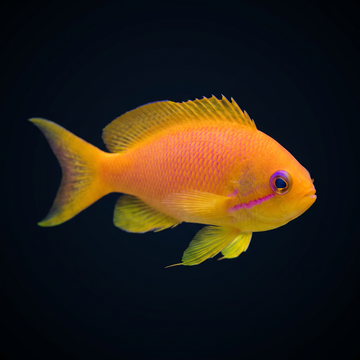
Princess Anthias

Overview:
Princess Anthias, scientifically known as Pseudanthias smithvanizi, thrive in well-maintained marine aquariums that replicate their natural habitat. They require a tank of at least 125 gallons with plenty of live rock for hiding and swimming space. Maintaining stable water conditions is crucial, with temperatures between 72-78°F, a pH of 8.1-8.4, and specific gravity of 1.020-1.025. Strong water movement and efficient filtration are essential to mimic their natural reef environment.

Compatibility:
Princess Anthias are generally peaceful but can be territorial, especially in smaller tanks. They do best in groups of one male with several females, as they naturally form harems. Avoid housing them with aggressive or overly dominant species. Suitable tankmates include other peaceful reef fish such as gobies, clownfish, and tangs. Ensure ample space and hiding spots to reduce stress and aggression.

Health and Quarantine:
Regularly monitor water quality and perform routine maintenance to prevent common health issues. Quarantine new additions for 2-4 weeks to observe for signs of disease and acclimate them to your tank's conditions. Princess Anthias are susceptible to marine ich and other parasitic infections, so maintaining optimal water quality and a stress-free environment is essential. A varied diet and proper tank conditions contribute to their overall health and longevity.

Pellets Mysis Finely Chopped Seafood
Princess Anthias swim in mid-water zones, showcasing graceful, darting movements. They are social, forming large schools with a distinct hierarchy led by a dominant male. Territoriality is minimal, as they prefer open spaces, but males may defend breeding territories. They are peaceful and compatible with non-aggressive species, thriving best in groups with a single male and multiple females.

FAQ

Frequently Asked Questions

About the Princess Anthias

  • How many Princess Anthias can I keep together, and what’s the ideal male-to-female ratio to maintain stable social behavior in a reef tank?
    Princess Anthias do best in a harem with one male and a group of females. In home aquaria, aim for 1 male with 4–8 females, depending on tank size. For tanks around 75–90 gallons, 1 male with 4–5 females is usually stable; for 120 gallons and up you can go to 1:8 if rockwork and flow are arranged to give multiple retreat areas. Avoid keeping more than one male unless the system is very large (180+ gallons) with lots of line-of-sight breaks; multiple males in smaller systems often leads to harassment, constant chasing, and suppressed feeding in subdominant males. When starting a group, it’s often safest to buy all females or juvenile unsexed fish and allow one to transition to male naturally, rather than buying a confirmed male and another large “female” that may already be transitioning.
  • My Princess Anthias are staying deep in the rockwork and only dart out during feeding. Is this normal for the species, or does it indicate a problem with lighting or aquascape?
    It can be normal early on, as this species is naturally found along drop-offs and outer reef slopes where they hover near structure and retreat quickly. However, if they continually hug the rockwork and only show briefly at feeding time, it often means the tank is too bright, too exposed, or they feel threatened. They usually feel most secure in high, broken rock structures that extend from bottom to midwater, with overhangs and ledges creating shaded zones. Very intense lighting without shaded areas can keep them withdrawn; adding overhangs, caves, and sections of dimmer light (or using a ramped sunrise/sunset schedule) usually encourages them to occupy more of the midwater column. Also ensure there are no overly boisterous tankmates (large wrasses, tangs that chase, or aggressive dottybacks), as these can keep Princess Anthias pinned in the rockwork.
  • Princess Anthias seem to lose color and look washed out after a few months in captivity. What specific dietary elements help maintain their natural pink and yellow coloration?
    Their coloration depends heavily on carotenoid-rich foods and overall protein quality. In the wild they feed constantly on zooplankton, especially tiny crustaceans. To keep their colors strong, base the diet on small, varied, planktonic-style foods: enriched mysis shrimp, finely chopped krill, Calanus, PE Mysis “pellets” sized for anthias, high-quality marine pellets with astaxanthin and other carotenoids, and frozen blends that include copepods and cyclops. Feed at least 2–3 times daily (4–5 small feedings is even better if nutrient control allows) to mimic their natural grazing pattern. Periodically use vitamin and HUFA (omega-3) enrichment on frozen foods, and rotate in foods specifically labeled as containing astaxanthin or krill meal. Poor color is usually a combination of low carotenoid intake and infrequent feeding, not just genetics.
  • My established female Princess Anthias is starting to show more intense coloration and chasing the others. How can I tell if she is transitioning to male, and should I intervene?
    In Princess Anthias, the dominant female will often begin transitioning if no male is present or if the existing male is weakened. Signs of transition include: increased intensity in pink/orange coloration, more pronounced fin edges, more assertive swimming in the open water, and frequent displays toward other females (short chases, flared fins, and “hovering” over subordinates). You don’t need to intervene unless the aggression becomes excessive and a particular subordinate is clearly being bullied away from food and shelter. In that case, rearrange rockwork to break established territories and, if necessary, temporarily remove the aggressor or the most harassed fish. If you already have a healthy, dominant male, and a female begins pushing him around and coloring up, it can be a sign the male is compromised (age, parasites, internal issues). Check the male for weight loss, frayed fins, or rapid breathing, as the group may be “replacing” him.
  • Princess Anthias in my high-flow SPS tank struggle to grab food in the main display. How can I design flow and feeding strategies that match their natural feeding behavior without starving them or overfeeding the corals?
    In nature, Princess Anthias hold position in strong but laminar or gently oscillating currents as they snatch passing zooplankton. In aquaria, very chaotic flow right at the surface or a single powerful gyre can push food past them too quickly. Aim for strong but more “organized” flow in at least one feeding zone: use alternating pumps or a feed mode to temporarily reduce peak turbulence during feeding, or direct some pumps at the surface to create a calm midwater lane. Target their preferred depth (usually midwater level near rock structure) when dosing fine particulate foods and small meaty items, so food drifts through their “hover zone” rather than blasting across the surface or dropping straight to the sand. Automatic feeders with small pellet sizes can be programmed for several tiny feedings during the light period; combined with a brief flow reduction at those times, this simulates a steady plankton stream and allows Princess Anthias to feed efficiently without dramatically increasing nutrient load.