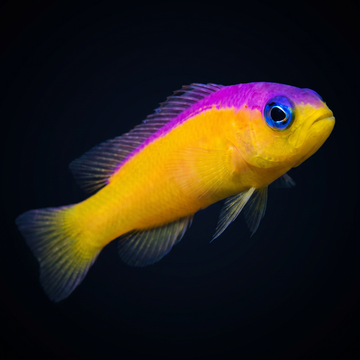
The Orchid Dottyback is a slender, elongated basslet endemic to the Red Sea, instantly recognizable by its saturated hot-pink to magenta or violet body, blue-violet accents along the fins, and a thin dark stripe running through the eye. Adults reach roughly 3 inches, with reported maximums spanning approximately 2.5 to 3 inches. In the wild it is a reef-associated species that patrols vertical rock faces, ledges, and overhangs, retreating instantly into small holes when disturbed.
A 30-gallon aquarium is the sensible minimum for a single adult, and additional volume with correspondingly more rockwork becomes important if more than one is kept. Aquascaping matters more than footprint alone: build the rockwork with cracks, caves, ledges, and small refuges so the fish can claim a home hole and dart in and out freely. Substrate choice is flexible, as sand, crushed coral, or a bare bottom all work equally well. Moderate water movement and stable marine conditions suit the species, and a tight-fitting lid is essential because dottybacks are capable jumpers. Newly added specimens often spend most of their time inside the rockwork before venturing into open water as they settle in.
On the reef, the Orchid Dottyback is a zooplankton hunter, darting out from cover to snatch passing prey before retreating to its ledge. This carnivorous habit translates directly to the aquarium, where a varied menu of meaty foods keeps color and condition at their best. Mysis shrimp, brine shrimp, krill, finely chopped marine flesh, and quality carnivore-oriented marine pellets or flakes are all appropriate.
Feeding response is typically excellent, and captive-bred specimens in particular take prepared foods without hesitation. Offer food at least once daily; two or three small meals spread through the day suit the fish's opportunistic feeding style even better. Watch feeding carefully in mixed communities, since an overly assertive tankmate can drive a dottyback into hiding and cost it meals.
This is an active, feisty fish that establishes a territory around a chosen cave or section of rockwork and defends it, though it is generally less aggressive than most other dottybacks. It may chase smaller fish and tends to be intolerant of conspecifics and of fish that share a similar size, shape, or color. Keeping a single specimen is the simplest approach. Pairs and harems have been maintained successfully in larger, heavily aquascaped systems, provided all individuals are introduced at the same time and given abundant hiding places.
Choose tankmates that are larger and visually dissimilar rather than small and docile, while avoiding excessively aggressive species that will bully the dottyback into permanent hiding. In the reef aquarium it is a reliable resident, ignoring soft corals, LPS, SPS, and sessile stinging invertebrates. Reef safety does not extend to every small animal, however: this fish has been observed hunting young bristleworms, small mantis shrimp, and other diminutive crustaceans or benthic invertebrates. Cleaner shrimp, hermit crabs, snails, and urchins are generally reported as safe, so the practical caution applies to prey-sized invertebrates only.
What is the minimum aquarium size for an Orchid Dottyback?
A 30-gallon aquarium is the recommended minimum for an adult. Additional volume and more extensive rockwork are advisable if more than one individual will be housed together.
Can more than one Orchid Dottyback be kept together?
Yes, though with care, since conspecific aggression is possible. Multiple specimens need a larger aquarium with ample rockwork and should be introduced simultaneously, typically as a pair or small harem.
Is the Orchid Dottyback safe for a reef aquarium?
It is reef safe and ignores corals and sessile stinging invertebrates, including soft corals, LPS, and SPS. Very small motile invertebrates such as young bristleworms, tiny mantis shrimp, and other diminutive crustaceans may be eaten.