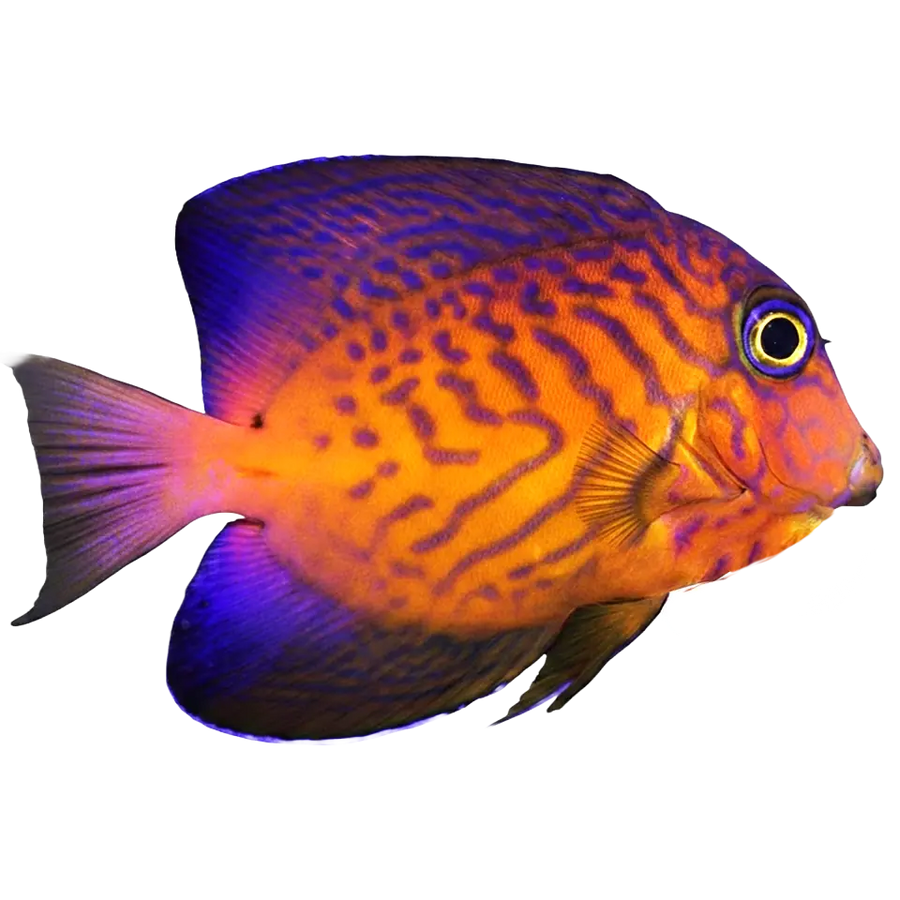
Hybrid Achilles–White Cheek Tang saltwater fish care guide

Overview:
The Hybrid Achilles–White Cheek Tang is a striking marine fish known for its vibrant coloration and active swimming behavior. Ideal habitat conditions for this species include a well-established aquarium of at least 100 gallons, equipped with ample live rock for grazing and hiding. The water should be maintained at a temperature of 72-78°F, with a pH of 8.1-8.4, and specific gravity between 1.020-1.025. Strong water movement and efficient filtration are crucial to mimic their natural reef environment and maintain water quality.

Compatibility:
The Hybrid Achilles–White Cheek Tang can be territorial, especially towards other tangs or fish with similar body shapes. It's best to introduce them as the last fish in a community tank to minimize aggression. They are generally compatible with a variety of other marine species, including peaceful fish, invertebrates, and corals. Avoid housing them with overly aggressive species or multiple tangs unless the tank is large enough to provide ample space for each fish to establish its territory.

Health and Quarantine:
Maintaining optimal water quality and a stress-free environment is essential for the health of the Hybrid Achilles–White Cheek Tang. They are susceptible to marine ich and other parasitic infections, so a quarantine period of at least 2-4 weeks is recommended before introducing them to the main tank. During quarantine, monitor for signs of disease and treat as necessary. Regularly check water parameters and perform routine water changes to prevent the buildup of harmful substances. Providing a varied diet and maintaining a stable environment will help bolster their immune system and promote overall health.

Nori Pellets Mysis
The Hybrid Achilles–White Cheek Tang is an active swimmer with aggressive tendencies, requiring a minimum of 120 gallons to thrive. Their territorial nature makes them challenging to house with similar species, although they are reef-safe. These tangs are best suited for experienced aquarists who can provide a stable environment and carefully select compatible tank mates. They are omnivores, feeding on algae and meaty foods, and require a varied diet to maintain their health and coloration.

FAQ

Frequently Asked Questions

About the Hybrid Achilles–White Cheek Tang

  • How can I visually confirm that my tang is a true Achilles–White Cheek hybrid and not just a stressed Achilles or White Cheek Tang?
    A genuine Achilles–White Cheek hybrid typically shows a mix of both parents’ traits: - Tail and caudal spot: The Achilles-style orange/red teardrop near the tail base is usually present but smaller or slightly misshapen, and the tail may not be as starkly white as a pure Achilles, often off-white or greyish with a faint edge. - Face mask: More like a White Cheek, with a dark head and a distinct white patch behind the eye, but this patch can be slightly irregular or reduced in size. - Body color: Dark brown to nearly black, but often a bit warmer brown than a pure Achilles and not as uniformly chocolate as a pure White Cheek. Some show a subtle gradient from darker head to slightly lighter body. - Dorsal/anal fin edging: Orange to yellow edging is usually present on both dorsal and anal fins; in hybrids, it’s sometimes thinner or less sharply defined than in pure species. - Overall shape: The body shape is intermediate, with Achilles’ more streamlined profile and the slightly deeper body seen in White Cheeks. When in doubt, compare multiple reference photos of confirmed hybrids and pure specimens from reputable importers or public aquariums; hybrids usually show at least three of the above mixed features at once.
  • What tank size and aquascape layout work best specifically for a hybrid Achilles–White Cheek Tang to minimize stress and aggression?
    Aim for a minimum of 6 feet in length (180–220 gallons for a single specimen), even though the hybrid may stay slightly smaller than a pure Achilles. They are highly active, constant swimmers that need a long, unobstructed “racetrack” lane along the front or back of the tank. Layout tips: - Rockwork: Build a firm central reef structure with multiple arches, pass-throughs, and at least 3–4 distinct “hide zones” where the tang can duck out of line-of-sight. Keep 4–6 inches of clear sand or bare bottom around the outer perimeter to create a smooth swimming loop. - Flow: They prefer strong, turbulent flow similar to a high-energy reef; use alternating gyres or random flow modes that sweep across the length of the tank. Avoid blasting one corner only, which can stress them as they constantly battle a one-directional current. - Line-of-sight breaks: Position rock and branching corals so that from any point in the tank, there is a way to break direct eye contact with other tangs. This is vital for reducing circling and tail-slapping behavior.
  • My hybrid Achilles–White Cheek Tang is eating nori but ignoring prepared foods. What specific feeding strategy helps transition this hybrid onto a varied diet without causing digestive or stress issues?
    These hybrids often start as heavy grazers and can be slow to accept new foods. Use a staged approach: - Step 1 (first 1–2 weeks): Offer several small sheets of high-quality green nori (and later red nori) daily on multiple clips to mimic natural grazing. Add a small amount of spirulina-based flake or small pellets near the clip so they “accidentally” sample them while going for the nori. - Step 2: Soak finely chopped frozen foods (mysis, brine, marine cuisine blends) in a vitamin and garlic supplement, then press a thin layer directly onto the nori sheet before placing it in the tank. As the fish tears the nori, it will ingest frozen pieces. - Step 3: Once it is clearly swallowing the frozen, start feeding in the water column just before you put in the nori. Turn off strong flow briefly and keep the food concentrated in its accustomed grazing zone. - Long term: Maintain a strong base of marine algae (nori, seaweed blends, spirulina pellets) with smaller daily portions of protein foods. Avoid large, infrequent high-protein feeds that can bloat them and degrade water quickly, which this hybrid is particularly sensitive to.
  • Why do hybrid Achilles–White Cheek Tangs seem “disease magnets,” and what specific quarantine and acclimation protocol should I follow to give them the best survival chance?
    Both parent species are highly prone to Cryptocaryon (marine ich) and Amyloodinium (velvet), and the hybrid inherits this sensitivity. Their constant activity, high oxygen demand, and easily irritated skin and gills make even mild parasite loads dangerous. For best results: - Quarantine length: 4–6 weeks minimum in a stable, fully cycled QT with high aeration and plenty of hiding PVC. - Prophylactic treatment: Use either a copper-based regimen at stable, tested therapeutic levels for 14–21 days or a hybrid strategy like 2 rounds of tank-transfer method (TTM) for ich plus a separate course for flukes (e.g., praziquantel) if your experience allows. Maintain strict salinity and temperature stability throughout. - Acclimation: Drip-acclimate over 45–60 minutes, then give 24–48 hours in dim light with no treatment other than observation and oxygenation before starting medication, unless the fish is showing advanced velvet symptoms (in which case treat immediately). - Stress reduction: Provide constant nori from day one, low lighting, a tight lid to prevent jumping, and minimal disturbance. These steps significantly reduce cortisol, which in turn supports immune function and helps the fish tolerate treatments better.
  • How should I manage compatibility and introduction order when adding a hybrid Achilles–White Cheek Tang to an existing tang community in a reef tank?
    This hybrid often behaves more assertively than a pure White Cheek and can rival an Achilles in territoriality, especially toward other Acanthurus. To maximize success: - Introduction order: Ideally add the hybrid last, after other tangs have already settled, or add it alongside other new tangs of similar size so no one fish is singled out. - Size matching: Avoid large mismatches; introduce the hybrid at equal or slightly smaller size than the most dominant existing tang. A significantly larger hybrid can become the tank bully. - Shape grouping: Avoid housing with other similar-shaped Acanthurus (e.g., Achilles, White Cheek, Powder Brown, Powder Blue) in smaller systems; if done in very large tanks, introduction should be simultaneous and with heavy feeding for several weeks. - Distraction techniques: Before introduction, rearrange some rockwork to reset territories and feed heavily with multiple nori clips spread around the tank so aggression is diluted. Use an acclimation box for 2–5 days to let existing fish see but not attack the newcomer. - Monitoring: Watch behavior closely for the first week; brief chasing and fin displays are normal, but sustained tail-slapping, constant pinning in corners, or shredded fins may require removing either the hybrid or the most aggressive rival.