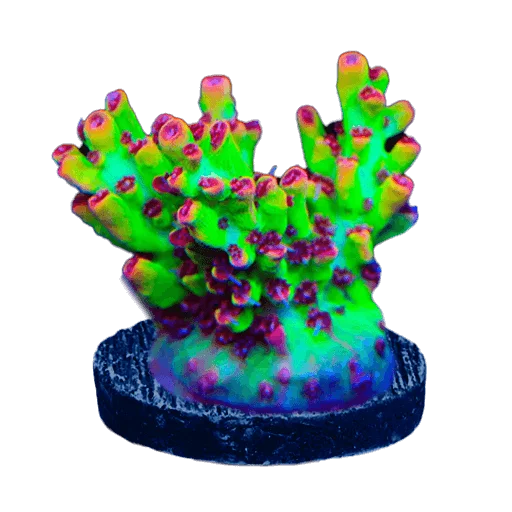
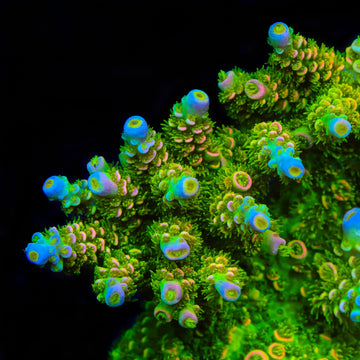
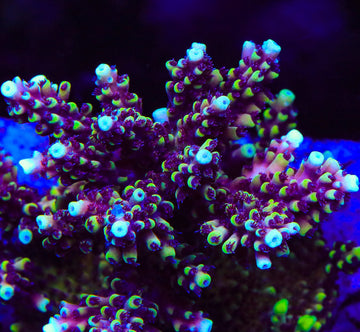
RR Robinhood Acropora Coral
Overview
RR Robinhood Acropora Coral shows branching, stick-like growth with tight axial tips. Acropora sp. is a small-polyp stony coral forming arborescent structures; it prefers strong lighting and high, turbulent water flow. It is primarily photosynthetic via symbiotic algae, though occasional small-particle foods can support growth and help maintain color. Place high on stable rockwork with space from aggressive neighbors, and ensure stable parameters to prevent tissue stress.
Quick Facts
Care
Difficult
Lighting
High
Flow
High
Placement
High
Temperament
Peaceful (2–3 inches spacing)
Recommended Parameters
Temp
76–80°F
pH
8.1–8.4
Salinity
1.025–1.026
Calcium
420–450 ppm
AlkAlkalinity
8–9 dKH
Magnesium
1250–1350 ppm
Feeding
photosynthetic, microplankton, phytoplankton, zooplankton, rotifers, copepod nauplii, oyster eggs, coral-specific powdered foods, amino acid supplements
Care & Placement
FAQ
Frequently Asked Questions
About the RR Robinhood Acropora Coral
-
Why is my RR Robinhood Acropora losing its signature color?
Color shifts often trace to spectrum, PAR, and nutrient balance. Target 250–400 PAR with strong, turbulent flow; acclimate slowly to avoid photoinhibition. Keep nitrate 5–15 ppm and phosphate 0.03–0.08 ppm—too lean pales it, too rich browns it. Stable alkalinity (8–9 dKH) is vital. Trace elements matter: potassium supports pink/red tones; iron can deepen greens. Test and dose carefully. -
Does RR Robinhood grow differently from other Acropora?
Expect a long encrusting phase before vertical shoots, especially if fragged small. Flow dictates form: high, crosscurrent flow promotes compact branching; weaker flow can push a more plate-like habit. Give 2–3 inches clearance from neighbors to avoid shading as it gains height. Mount on a stable plug or rock edge to encourage faster encrustment and thicker bases. -
How can I spot and handle uncommon pest issues on this coral?
Watch for semicircular bite marks or sand-like eggs—signs of AEFW—and tiny golden specks for red bugs. Use a bright flashlight 30–60 minutes after lights out to inspect polyps. Respond with scheduled broad-spectrum coral dips and manual egg removal. A pest-hunting wrasse (Halichoeres spp.) helps control stragglers. Maintain stable parameters to reduce stress-driven tissue loss (STN/RTN). -
My colony stalls after encrusting—how do I trigger vertical growth?
Increase turbulent flow across the entire rim, not just one side, and ensure PAR is uniform over the base. Slightly raise the frag to reduce boundary layer drag. Trim nearby shadows and remove nuisance algae along the encrustment edge. Confirm consistent daily alkalinity and a small but steady nutrient supply; even tiny dips in nitrate can halt new axial tips.