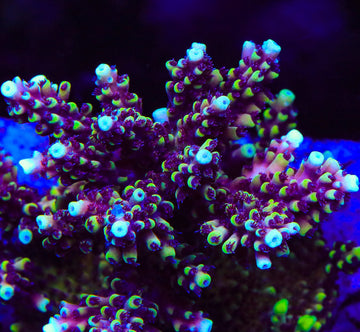
Pacman Acropora Coral
Overview
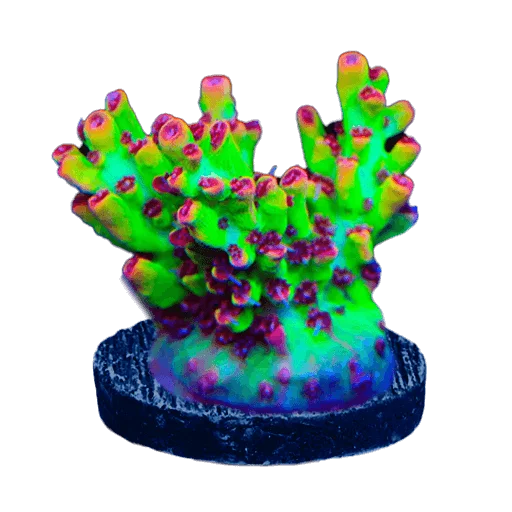
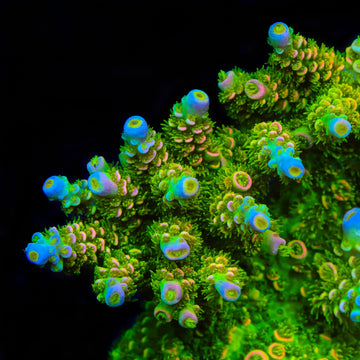
Pacman Acropora Coral shows bright yellow to green branches with contrasting polyp tips. Acropora tenuis is a branching small-polyp stony coral that prefers strong light and high, turbulent water flow. It relies on symbiotic algae for most nutrition, but occasional small particle foods can support growth and maintain coloration. Place high on stable rockwork with space from aggressive neighbors, and keep conditions stable to avoid tissue loss.
Quick Facts
Care
Difficult
Lighting
High
Flow
High
Placement
High
Temperament
Peaceful (2–3 inches spacing)
Recommended Parameters
Temp
76–80°F
pH
8.1–8.4
Salinity
1.025–1.026
Calcium
420–450 ppm
AlkAlkalinity
8–9 dKH
Magnesium
1280–1350 ppm
Feeding
photosynthetic (primary), microplankton, rotifers, copepod nauplii, coral-specific powdered foods (e.g., Reef-Roids), oyster eggs, amino acids, phytoplankton (limited)
Care & Placement
FAQ
Frequently Asked Questions
About the Pacman Acropora Coral
-
Why does my Pacman Acropora (Acropora tenuis) fade from neon yellow with blue tips to dull green?
Color shifts usually trace to spectrum, PAR, and nutrient balance. Aim for 250–400 PAR under blue-heavy lighting (peak 420–460 nm), with stable nitrate 5–15 ppm and phosphate 0.03–0.08 ppm. Keep alkalinity steady (7.5–8.5 dKH). Low potassium or iron can mute yellow; verify via ICP (K ~380–420 ppm, very low Fe). Stability over weeks, not days, restores pigments. -
How do I prevent tip burn or base recession when moving this coral higher in the tank?
Ramp PAR slowly (10–15% weekly), use a longer blue ramp at photoperiod start/end, and maintain strong, random flow—never a direct jet at the tips. Keep temp tight (24–26°C), alkalinity swings under 0.3 dKH/day, and avoid large water chemistry jumps. If the base pales, lower light slightly and increase flow across the encrusting rim. -
What placement helps maximize color while minimizing self-shading as it grows?
Give 10–15 cm clearance on all sides and angle the frag so branches receive crossflow. This species forms dense corymbs; pruning interior branches improves light to the base. Place mid–high on a clean, wide plug or shelf to encourage a strong encrusting skirt before vertical growth. Adjust flow to tumble detritus from inner branches. -
I’m seeing slow tissue necrosis on one side only—common for this coral. What’s the fastest save?
Stabilize parameters first, then frag 5–10 mm into healthy tissue beyond the recession line. Dip frags to exclude pests, mount on fresh plugs, and increase chaotic flow around the mother’s affected area. Check for AEFW bite marks or red bugs with a flashlight. Match new-frag lighting 20–30% lower for a week, and avoid large alkalinity corrections.