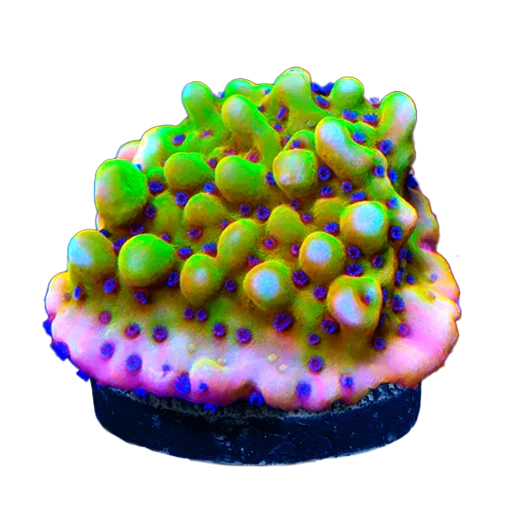
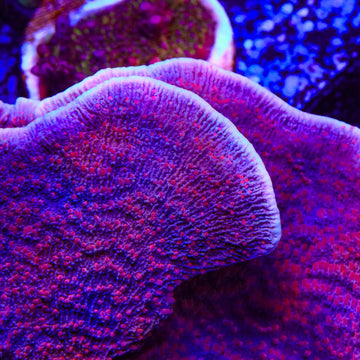
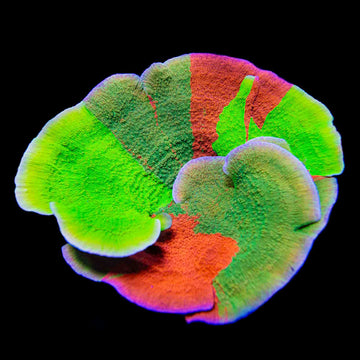
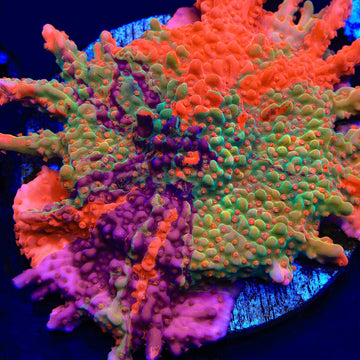
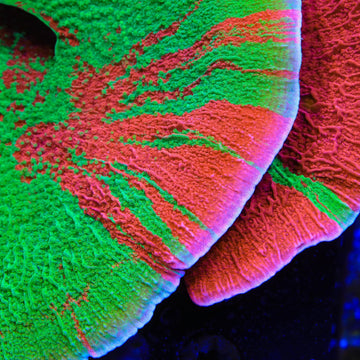
JF Sweet Tooth Montipora Coral
Overview
JF Sweet Tooth Montipora Coral displays a plating to encrusting surface with small, tightly spaced polyps and contrasting polyp tips. Montipora sp., a small-polyp stony coral that forms thin plates or encrusting mats, prefers moderate to high light and moderate to strong, turbulent water flow. It is primarily photosynthetic through symbiotic algae but can benefit from occasional fine particulate foods, which may support faster growth and stable coloration. Place on rockwork with room to spread and avoid contact with aggressive corals to prevent tissue loss.
Quick Facts
Care
Moderate
Lighting
Moderate–High
Flow
Moderate–High
Placement
Mid–High
Temperament
Peaceful (2–3 inches spacing)
Recommended Parameters
Temp
76–80°F
pH
8.1–8.4
Salinity
1.025–1.026
Calcium
400–450 ppm
AlkAlkalinity
8–9 dKH
Magnesium
1280–1350 ppm
Feeding
photosynthetic (primary), microplankton, phytoplankton, rotifers, copepod nauplii, powdered coral foods (e.g., Reef-Roids), marine snow, amino acid supplements
Care & Placement
FAQ
Frequently Asked Questions
About the JF Sweet Tooth Montipora Coral
-
My JF Sweet Tooth Montipora is losing its cotton-candy colors. What fine-tuning brings them back?
Prioritize spectrum and nutrients. Run strong blue/violet (420–470 nm) with some UV; avoid abrupt PAR jumps. Keep nitrate 2–10 ppm and phosphate 0.03–0.08 ppm—too lean pales, too rich browns. Stable alkalinity 8–9 dKH with balanced calcium/magnesium. Trace balance matters: potassium and iron support pinks/reds; don’t dose blind—test first. Improve random flow to keep tissue clean. -
How should I place it to control growth and prevent self-shading?
This morph encrusts, then plates. Start mid-light, strong cross-flow. Mount on a vertical or angled face so plates grow outward, not over the base. Give 2–3 inches clearance from neighbors; it loses to long sweepers but can overgrow mellow SPS. Periodically trim the rim to reduce shading and redirect growth. Rotate the rock quarterly to keep even light exposure. -
What’s the best strategy against Montipora-eating nudibranchs on this coral?
Check after lights out with a white flashlight; look for frilly white nudis and crescent egg ribbons under lips/rims. Quarantine, manually remove adults and eggs daily, and use a quality coral dip on a schedule (e.g., every 3–4 days for 2–3 weeks). Frag healthy margins away from affected zones. A vigilant wrasse (melanurus, yellow coris) can help, but don’t skip manual/qt protocol. -
I’m seeing slow recession from the base despite good numbers—what hidden causes should I check?
Look for vermetid snails and their mucous nets irritating tissue; remove them mechanically and epoxy over holes. Increase turbulent flow beneath the plate to prevent detritus accumulation. Check alkalinity swing history; even brief spikes trigger STN. Rule out shadowing from the coral’s own rim. An iodine-based dip can calm irritation; if recession advances, cut 3–5 mm ahead into healthy tissue.