Omnivore
Detritus
Leftover Fish Food
Microfauna
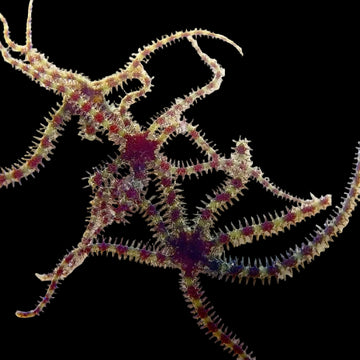
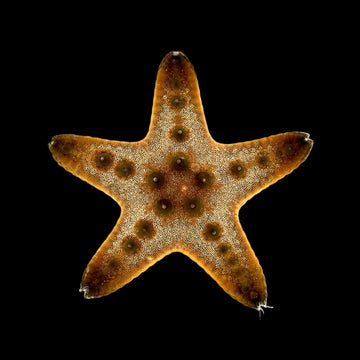
Micro Brittle Starfish are small, secretive scavengers that spend nearly their entire lives hidden within live rock, crevices, and the upper layers of the substrate. Rather than roaming openly like larger starfish, they extend one or more arms out from hiding to capture detritus, uneaten food, and suspended organic particles drifting through the water. They are primarily nocturnal, becoming more active after lights out when fish activity decreases. In mature reef systems, they often multiply naturally and form stable populations that quietly contribute to nutrient recycling. Because they remain hidden and non-invasive, they are rarely noticed unless observed at night or during feeding, making them ideal for reef tanks where subtle, behind-the-scenes cleanup is preferred.
FAQ
Frequently Asked Questions
About the Micro Brittle Starfish
-
I never see my Micro Brittle Starfish. Did it die or escape?
In most cases, it is alive and behaving normally. Micro Brittle Starfish are extremely secretive and spend nearly their entire lives hidden inside rockwork, rubble, and small crevices. Unlike larger starfish, they rarely travel openly across the tank. Most aquarists only notice them when feeding after lights out, when their arms extend from holes in the rock to capture food particles. If your tank has live rock and regular feeding, prolonged invisibility is expected and not a sign of loss. -
Are Micro Brittle Starfish actually beneficial, or are they just hitchhikers?
They are highly beneficial scavengers. Micro Brittle Starfish help process detritus, uneaten food, and organic waste trapped deep within rock structures that snails and crabs cannot reach. By breaking down this material, they contribute to nutrient recycling and overall tank stability. Their presence is often considered a sign of a healthy, biologically mature reef system. -
Will Micro Brittle Starfish reproduce in my aquarium?
Yes, they can. In stable, well-fed reef systems, Micro Brittle Starfish often reproduce naturally through fragmentation or larval settlement. This usually happens gradually and does not result in sudden population explosions. Their numbers tend to self-regulate based on available food and habitat space. -
Can Micro Brittle Starfish harm corals, fish, or other invertebrates?
No. They are completely reef safe and do not prey on corals, fish, shrimp, or snails. Their feeding strategy is passive scavenging rather than hunting. They coexist peacefully with all common reef inhabitants and pose no compatibility concerns. -
Do Micro Brittle Starfish need to be fed directly?
Direct feeding is not necessary. In most established reef tanks, normal fish feeding provides enough suspended food and detritus to sustain them. Attempting to target feed is usually unnecessary and can lead to excess nutrients rather than improved health.