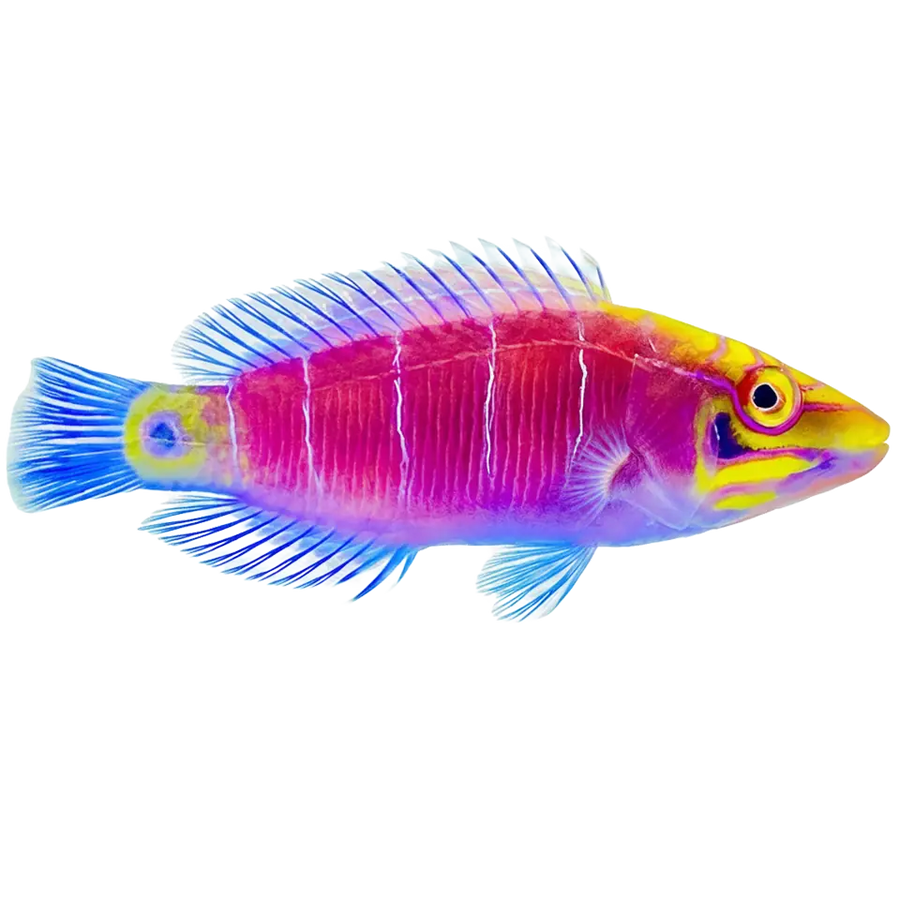
Hooded Flame Fairy Wrasse

Overview:
The Hooded Flame Fairy Wrasse, known for its vibrant colors and active nature, thrives in a well-maintained marine aquarium. This species requires a tank of at least 75 gallons with plenty of live rock for hiding and exploring. Optimal water conditions include a temperature range of 72-78°F, a pH level of 8.1-8.4, and a specific gravity of 1.020-1.025. Strong water movement and efficient filtration are crucial to mimic their natural reef environment. A secure lid is essential as they are known jumpers.

Compatibility:
This species is generally peaceful and can coexist with other non-aggressive fish. Ideal tankmates include other fairy wrasses, gobies, and tangs. Avoid housing them with overly aggressive species or those significantly larger, as this can cause stress. They can be kept singly or in a small group, provided there is ample space and hiding spots to establish territories. Introducing them to the tank last can help reduce territorial disputes.

Health and Quarantine:
The Hooded Flame Fairy Wrasse is susceptible to common marine diseases such as ich and velvet. A quarantine period of 2-4 weeks is recommended for new arrivals to monitor and treat any potential health issues before introducing them to the main tank. Maintain pristine water conditions and a stable environment to reduce stress and disease risk. Regular observation for signs of illness, such as changes in behavior or appetite, is essential. If symptoms arise, prompt treatment with appropriate medications is necessary to ensure recovery.

Pellets Mysis Finely Chopped Seafood
The Hooded Flame Fairy Wrasse is an active swimmer, often seen darting gracefully among corals. It is peaceful, typically non-territorial, and thrives in groups, showing vibrant colors during social interactions. Compatible with other peaceful species, it requires a spacious tank of at least 70 gallons to accommodate its active nature. It is reef-safe, posing no threat to invertebrates. Its diet consists of carnivorous fare like mysis and brine shrimp, necessitating regular feeding to maintain health and coloration.

FAQ

Frequently Asked Questions

About the Hooded Flame Fairy Wrasse

  • My male Hooded Flame Fairy Wrasse is losing his bright hood and red body color after a few weeks in my tank. What specific conditions tend to maintain their full adult coloration in captivity?
    Hooded Flame Fairy Wrasses hold their color best when three key factors are met: social structure, diet, and lighting. Socially, a single terminal male without any females may “relax” his display over time; keeping him with 2–4 compatible Cirrhilabrus females (or at least one female of his own species/complex, introduced first) usually keeps him in constant display mode and maintains the vivid hood and flank coloration. Diet-wise, they need multiple small feedings per day of high-quality, carotenoid-rich foods: PE mysis, enriched brine, finely chopped krill, calanus, and quality marine pellets with astaxanthin and spirulina help sustain red and orange hues. For lighting, they tend to look best under a spectrum that includes strong blue/violet channels (e.g., reef LEDs in the 16–20K range) with moderate intensity, combined with clear, low-nutrient water. Excessively bright white lighting with high nutrients and little blue can make them appear washed out. Good oxygenation and consistent, low-stress conditions (no aggressive tankmates, tight lid, stable temperature 76–78°F and salinity 1.025–1.026) round out long-term color stability.
  • I’d like to keep more than one Hooded Flame Fairy Wrasse in my tank. What’s the safest way to build a harem and avoid deadly aggression among males?
    For Hooded Flame Fairy Wrasses, the safest approach is to start with a group of juveniles/females and allow one to transition to male in your system. Aim for a ratio of 1 male to 3–5 females in tanks 4 feet (75–90 gallons) or larger with abundant rockwork and open swim space. If you already have a male, introduce females first, then the male last, using an acclimation box for him so existing fish can see but not touch him for 3–7 days. Avoid adding a second established male unless the tank is very large (6+ feet, 150+ gallons) and heavily aquascaped with multiple visual breaks; even then, aggression can be severe and may end with only one male. Introduce any additional males in boxes to assess the reaction before full release. Mix them only with peaceful or mildly assertive tankmates; damsels, dottybacks, and larger wrasses in the Thalassoma or Halichoeres groups can cause constant chasing that triggers male–male fighting in the fairy wrasses themselves.
  • My Hooded Flame Fairy Wrasse repeatedly launches itself into the lid at lights-out, sometimes scraping its snout. Is this species especially prone to “lights-off panic,” and how can I stop it without changing fish?
    Hooded Flame Fairy Wrasses are particularly jump-prone at sudden changes in ambient light, especially at lights-off and when room lights flick on or off abruptly. To reduce this behavior, transition lighting gradually: program your main lights to ramp down over 30–60 minutes and add a dim “moonlight” or low-level blue channel that stays on for at least 30 minutes after the main lights go out. Likewise, in the morning, bring up the room lights before tank lights, or ramp tank lights up over 30 minutes. Ensure the fish has a secure, sand-free “bolt hole” in the rock—small caves or overhangs where it can wedge itself at night. A snug-fitting mesh lid (¼″ or 1/8″ clear mesh) is absolutely mandatory for this wrasse in any tank. If the fish is already habituated to slamming the top, reduce stress by minimizing sudden movements near the tank in the dark period and avoid abrupt maintenance right before or after lights-out.
  • My new Hooded Flame Fairy Wrasse is pacing the glass non-stop and ignoring food while my established fairy wrasses eat normally. Is this a social integration problem unique to the species, or just typical new-fish behavior?
    Hooded Flame Fairy Wrasses are often more sensitive to social pressure during introduction than many other Cirrhilabrus. Their pacing and refusal to eat in the presence of existing fairy or flasher wrasses often indicates they’re being visually dominated even if you don’t see open fighting. Use an acclimation box for at least several days so the new fish can see other wrasses and learn the social layout without being chased; feed heavily right at the box to associate other fish with food, not fear. Adjust aquascape if needed to break up line-of-sight and add more arches and caves so the new wrasse has “escape lanes” and territories it can claim. If there is a particularly assertive resident fairy wrasse (e.g., a large male of another complex), consider temporarily confining that bully in a box or sump for a week while the Hooded Flame settles and starts eating. Once the new fish is feeding strongly on frozen foods and pellets in the box, and the residents no longer charge the box, release it near lights-out to reduce initial chase behavior.
  • I want to keep a Hooded Flame Fairy Wrasse in a mixed reef with high PAR SPS corals and strong flow. Are there any flow patterns, coral choices, or invertebrates that cause specific problems for this wrasse?
    Hooded Flame Fairy Wrasses do well in high-energy reef systems as long as the flow is broad and not a direct jet where they sleep or stage. Avoid pointing strong wavemakers directly at their preferred open-swim area or at caves they use at night; instead, angle pumps to create wide, turbulent gyres. They generally ignore corals but can be repeatedly startled by long-stinging LPS such as large Euphyllia, Galaxea, and big Favias placed in their flight path, which can cause frantic darting and jumps. Place such corals away from primary swimming corridors. They are usually safe with ornamental shrimp, but very tiny, newly molted shrimp may be sampled; larger cleaners (Lysmata, Stenopus) are usually fine. Avoid keeping them with very boisterous “rock perching” fish like large hawkfish that occupy the same midwater/rock edge area, as that can make the wrasse hang back in the rockwork and reduce feeding opportunities. Also ensure that strong flow doesn’t blast floating foods straight into overflows; these wrasses feed best when food lingers midwater long enough for multiple passes.