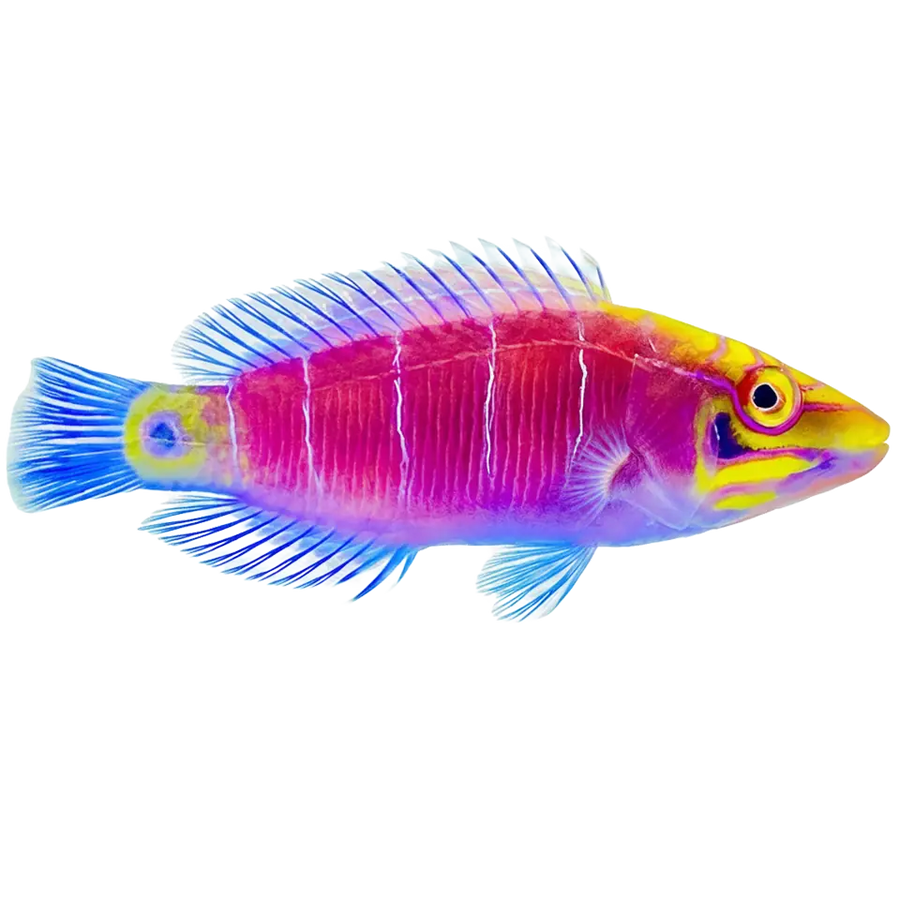
Conde’s Fairy Wrasse

Overview:
Conde’s Fairy Wrasse is a vibrant and active marine fish, best suited for well-established saltwater aquariums. They thrive in tanks of at least 55 gallons, providing ample swimming space and a variety of hiding spots using live rock. Ideal water conditions include a temperature range of 72-78°F, a pH of 8.1-8.4, and a specific gravity of 1.020-1.025. Maintaining stable water parameters with efficient filtration and regular water changes is crucial for their well-being. These wrasses are known for their jumping ability, so a tightly fitted lid is essential to prevent escape.

Compatibility:
Conde’s Fairy Wrasse is generally peaceful, making it a suitable addition to community reef tanks. They coexist well with other non-aggressive species but may display territorial behavior towards similar wrasses or smaller fish. Avoid housing them with overly aggressive or predatory tankmates. Introducing them to the tank last can help reduce territorial disputes. They are reef-safe, posing no threat to corals or invertebrates, making them an excellent choice for reef enthusiasts.

Health and Quarantine:
To ensure the health of Conde’s Fairy Wrasse, quarantine new arrivals for 2-4 weeks before introducing them to the main tank. This practice helps prevent the spread of diseases such as marine ich or velvet. Regularly monitor for signs of stress or illness, including changes in appetite, color, or behavior. Maintain high water quality and a stress-free environment to reduce the risk of disease. If health issues arise, consult a marine veterinarian for appropriate treatment options. Regular observation and proactive care are key to maintaining a healthy and thriving Conde’s Fairy Wrasse.

Pellets Mysis Finely Chopped Seafood
Conde’s Fairy Wrasse exhibits lively swimming patterns, often darting among rocks and coral. This species is non-aggressive, coexisting well with other peaceful fish. It shows minimal territorial behavior, making it suitable for community tanks. Compatible with other non-aggressive species, it thrives in groups, displaying vibrant colors during social interactions. This wrasse is active during the day, retreating to crevices at night. Its peaceful nature and reef-safe status make it an excellent choice for marine aquariums.

FAQ

Frequently Asked Questions

About the Conde’s Fairy Wrasse

  • How can I reliably identify a Conde’s Fairy Wrasse (Cirrhilabrus condei) and avoid confusing it with similar fairy wrasses like C. lubbocki or C. cyanopleura when buying one for my reef tank?
    Conde’s Fairy Wrasse males show a pale to bright yellow body with a pink to red head/face, a bluish to purple dorsal area, and a distinct darker band or shading through the mid-body, plus blue edging on the dorsal and caudal fins that intensifies when they flash. The tail is usually rounded to slightly lyre-shaped, not deeply forked like some larger Cirrhilabrus. Females/juveniles are more subdued, often tan to light yellow with a faint lateral stripe and less dramatic finnage. Compared to Lubbock’s Fairy Wrasse, Conde’s typically has a more uniform yellow body (instead of blotchy pastel patches) and a less strongly segmented color pattern on the dorsal fin. Compared to C. cyanopleura, Conde’s is smaller, more delicate, and lacks the strong electric blue lateral stripe. Always ask for the scientific name (Cirrhilabrus condei), inspect clear photos or videos under white light (not just blue actinics), and avoid specimens with frayed fins, cloudy eyes, or heavy breathing.
  • Are Conde’s Fairy Wrasses truly “reef safe,” and what specific corals or invertebrates might they nip at or disturb in a mixed reef aquarium?
    Conde’s Fairy Wrasses are considered reef safe with respect to corals; they do not eat or nip at SPS, LPS, soft corals, zoanthids, or clams under normal conditions. They are active water-column feeders, hunting tiny zooplankton and prepared foods rather than pecking at coral tissue. However, they will consume very small crustaceans such as copepods, amphipods, tiny shrimp larvae, and occasionally feather duster worms or small fan worms if the worms’ crowns are repeatedly exposed. They generally ignore cleaner shrimp, larger ornamental shrimp (like adult Lysmata species), and larger feather dusters. They may investigate very small sexy shrimp or anemone shrimp, especially if these are newly added and not well sheltered. Provide regular feedings of quality frozen and pelleted foods so they do not obsessively pick at microfauna on the rockwork.
  • What tank size and aquascape layout works best for a single male Conde’s Fairy Wrasse, and does this species need open water or a rock-heavy setup?
    For a single Conde’s Fairy Wrasse, a minimum of 40–50 gallons is recommended due to their near-constant swimming and darting behavior. They use the full water column, so a tank at least 90 cm (3 feet) long is better than a tall, narrow tank. Provide a rock structure with multiple caves, arches, and overhangs that extend toward the center of the tank, not just a pile of rock against the back wall. This species likes to weave quickly through rockwork, then shoot out into open space, so include at least one clear, open “runway” from front to back or side to side. Leave some sand area open for their sleeping behavior if you use a sandbed (they dive into sand or wedge into rock crevices at night), and keep high-intensity flow pointed along the upper third of the tank while leaving calmer spots lower down where they can rest.
  • How should I introduce a Conde’s Fairy Wrasse into a tank already housing other fairy wrasses and flasher wrasses to minimize aggression and stress?
    Quarantine first and allow the Conde’s Fairy Wrasse to fatten up and settle in. When ready to move it to the display, rearrange some of the rockwork to disrupt pre-existing territories. Use an acclimation box for 3–7 days inside the display tank; this allows your current wrasses to see and posture at the newcomer without contact. Observe how males of similar body shape and color (especially other Cirrhilabrus with yellow or red heads) behave. If a resident male repeatedly charges the box or flares nonstop, consider introducing the Conde’s at the same time as another new wrasse to spread aggression, or rehome the most aggressive individual. Release the Conde’s near lights-out so it has dimmer conditions to explore and find shelter. Maintain a tight lid, as both resident and new wrasses may jump during the initial dominance sorting period.
  • What specific feeding strategy keeps a Conde’s Fairy Wrasse in top condition, and how many times per day should they be fed in a mature reef tank?
    Conde’s Fairy Wrasses do best with multiple small meals rather than one large feeding. Aim for 2–3 feedings per day if possible. Use a varied diet: quality marine pellets (small, slow-sinking), frozen mysis, enriched brine shrimp, finely chopped krill or clam, and frozen “reef blend” foods. Supplement with foods rich in astaxanthin and other carotenoids to maintain yellow and red coloration. They tend to feed midwater, so broadcast feed rather than target feed on the substrate. If you run high nutrient export (aggressive skimming, refugium, or roller mats), you can safely feed more frequently, but monitor nitrate and phosphate to avoid overpollution. Newly imported or thin individuals may need 3–4 smaller feedings per day for the first few weeks to regain weight, then can be tapered to a stable 2–3 feedings as their body condition improves.