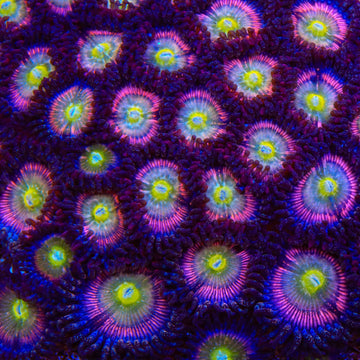
Sour Blueberry Zoanthids Coral
Overview
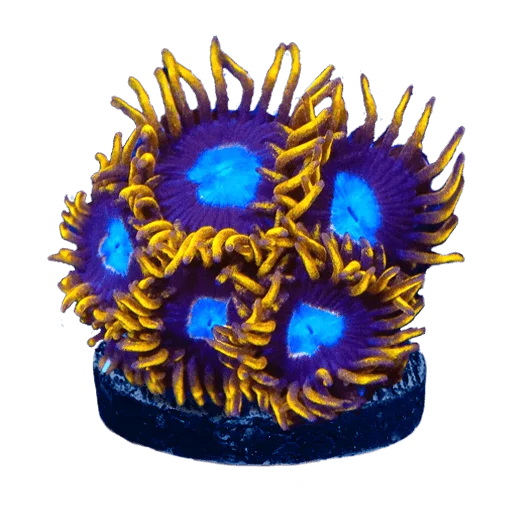
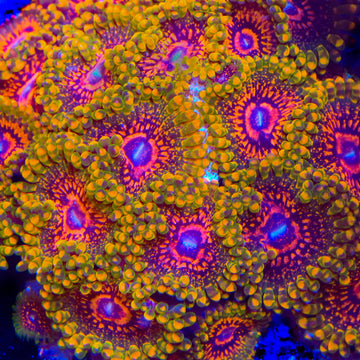
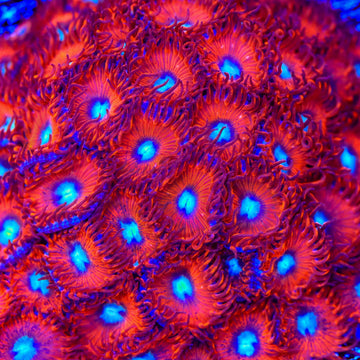
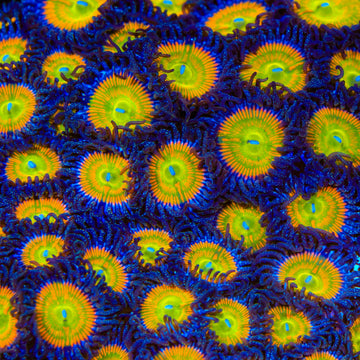
Sour Blueberry Zoanthids Coral has small button-like polyps with blue to purple centers and contrasting skirts. Zoanthus sp., a soft colonial polyp that forms mats, prefers moderate light and gentle to moderate water flow. It is primarily photosynthetic with symbiotic algae, but occasional small particulate foods can support faster growth and richer color. Place on an isolated rock to control spreading and avoid contact with aggressive neighbors; handle with care due to potential toxins.
Quick Facts
Care
Easy
Lighting
Low–Moderate
Flow
Moderate
Placement
Low–Mid
Temperament
Semi-aggressive (3–4 inches spacing)
Recommended Parameters
Temp
76–82°F
pH
8.1–8.4
Salinity
1.025–1.026
Calcium
400–450 ppm
AlkAlkalinity
8–9 dKH
Magnesium
1250–1350 ppm
Feeding
photosynthetic, phytoplankton, microplankton, rotifers, copepod nauplii, cyclops, oyster eggs, powdered coral foods (e.g., Reef-Roids), marine snow, amino acids
Care & Placement
FAQ
Frequently Asked Questions
About the Sour Blueberry Zoanthids Coral
-
Why do Sour Blueberry Zoanthids shift from bright blue to duller tones, and how can I keep their color stable?
This morph is sensitive to spectrum and nutrients. Too much white light or very high PAR can wash out blues; ultra-low nutrients can pale them. Aim for strong blue spectrum, moderate PAR (100–150), steady nitrate 5–10 ppm and phosphate 0.03–0.08 ppm. Avoid sudden spectrum changes; acclimate with light diffusion and maintain trace elements via regular water changes. -
My polyps look “stretched” with long skirts and small centers. What’s causing this?
Stretching usually points to low PAR and uneven flow. Increase PAR gradually to the target range and provide crossflow that gently sways skirts without blasting the oral disc. Check for film algae or detritus on the mat, which can irritate polyps. Stable alkalinity and potassium also support full, round polyp expansion. -
How can I control their rapid spread without harming the colony or neighbors?
Mount the frag on an isolated “island” rock with a sand moat or a rubble border the mat can’t cross easily. Trim the advancing mat with a sharp scalpel and remove the cut strip. Run fresh carbon to manage chemical cues after trimming, and keep at least 2–3 inches from slow encrusters and prized acros. -
What pests and diseases target this morph, and what’s the best detection and treatment plan?
Watch for zoa-eating nudibranchs, sundial snails, and zoa spiders; zoa pox shows as tan bumps on stalks. Inspect after lights out with a red flashlight. Treat with a focused dip (iodine-based or coral-safe pesticide per instructions), manually remove egg spirals, and quarantine new frags. Handle with gloves and eye protection; avoid aerosolizing dip water.